Blog
Get your website ready for the holidays
November 5, 2026 · 5 min · Neil Black
- holidays
- small business
- website basics
Thanksgiving is Thursday, November 26. Between now and New Year's Day, people will look up a local business for a plain reason: are you open, and can they still get what they need. Your website and your Google listing should answer that before they have to call.
One evening covers hours, a shipping date if you sell goods, and the words on a holiday offer.
Tell people whether you are open
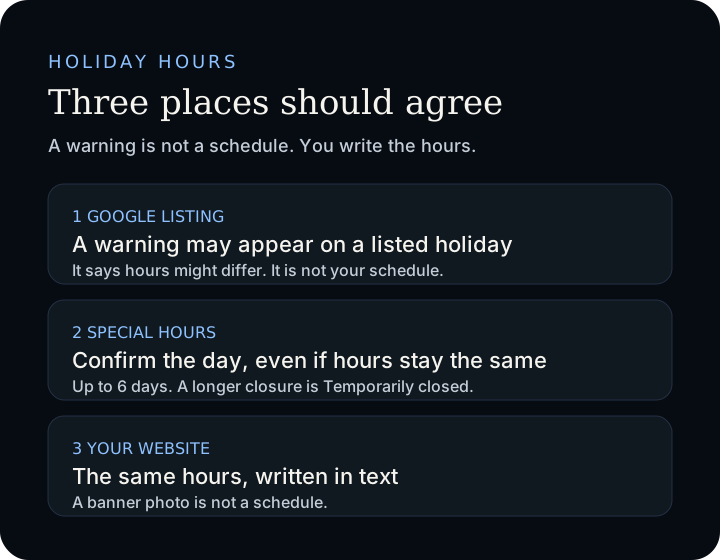
On certain holidays, Google may show a warning on your Business Profile that your hours might differ. The public list is About holidays on Google (opens in a new tab), sorted by country. For the United States, the dates still ahead include Thanksgiving on November 26, Black Friday on November 27, Christmas Eve on December 24, Christmas on December 25, New Year's Eve on December 31, and New Year's Day on January 1, 2027. You set the real schedule.
Special hours (opens in a new tab) cover a short change: a holiday, an event, or a closure of up to 6 days in a row. Google says it is worth confirming official holidays even when you are keeping a normal day, so customers can see those hours are accurate. A closure of 7 or more days, or a closure with no known end, is different: that page says to mark the business temporarily closed. Special hours show only when the profile is set to "Open with main hours."
Put the same hours on the website, in words, near the phone number. A photo of a wreath is not a schedule. If the site uses local business structured data (opens in a new tab), Google's winter-closure example sets opening and closing to 00:00 and adds validFrom and validThrough. The visible words still have to match, and the label does not guarantee a special display. The longer profile checklist is in How to set up a Google Business Profile.
If you ship, name a date you can keep
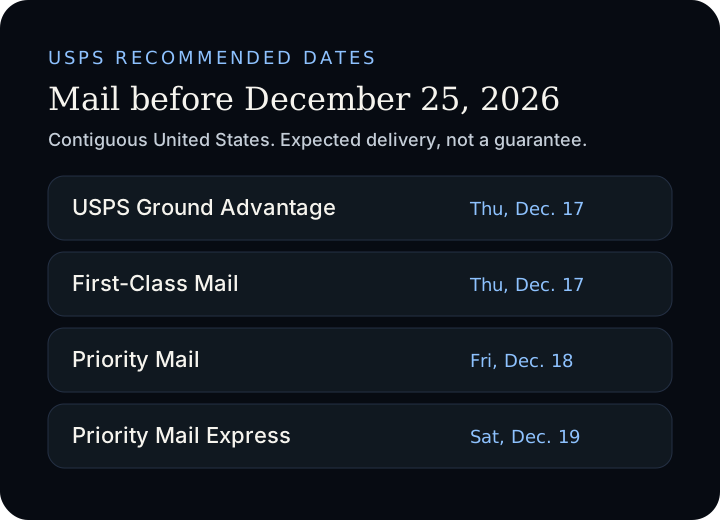
The Postal Service published recommended send-by dates for expected delivery before December 25, 2026. For the contiguous United States, the USPS holiday page (opens in a new tab) lists December 17 for Ground Advantage and First-Class Mail, December 18 for Priority Mail, and December 19 for Priority Mail Express. USPS says the real date can vary with origin, destination, acceptance time, and other conditions. Hanukkah is December 4 through December 12, so that gift needs an earlier date. Alaska, Hawaii, territories, military mail, and international mail have separate tables on the same page.
Those dates are a mailing calendar. They are not a promise your shop can make on its own. When a customer orders goods by mail, phone, or the internet, the FTC's Mail Order Rule (opens in a new tab) covers most of those orders. You need a reasonable basis for any ship time you state or imply. With no clear time stated, you need a reasonable basis to ship within 30 days of a properly completed order. That basis looks at expected demand, stock or a real supply source, and whether fulfillment can handle the season. The clock starts when the order arrives with the payment you accept and the details you need.
If you cannot ship on time, tell the customer, give a revised date, and explain how to cancel for a full, prompt refund. Prompt Delivery Rules (opens in a new tab) is the short version. "Order by December 18 for Christmas" on the homepage is a shipment claim. Use a date you can support, or a number of days you can support. A business that does not mail merchandise can skip this part.
Say what the offer really is
A holiday banner is an ad. The FTC's advertising FAQ for small businesses (opens in a new tab) restates the rule: advertising must be truthful and not deceptive, you need evidence before the ad runs, and an ad cannot be unfair. The FTC reads words and pictures together, and it looks at what you leave out when that gap would mislead a reasonable customer. Price and features are claims that matter to a buying decision.
A sale price follows the same standard. The FAQ points to the Guides Against Deceptive Pricing, notes that every state has its own rules for ads, and says many pricing questions belong with the attorney general where you advertise.
If a deal is only for the first few buyers, or only at one shop, say so beside the offer. The rain-check rule is for retail food stores. The FAQ says other businesses advertising a limited quantity, or an item at only some stores, may want a similar note. For a free extra with a purchase, the paid item's price should not rise to cover the gift, and the terms should sit near the price. The FTC's .com Disclosures (opens in a new tab) guide says a disclosure works better close to the claim it explains.
Gift cards need a look before you promote them. The Consumer Financial Protection Bureau says gift card funds must last at least five years (opens in a new tab) under federal law, and that some states allow more time. An inactivity fee is allowed only after 12 months with no activity, and only when the other federal conditions are met. Check the terms on the card and on the page where someone buys it.
Walk the page on your phone
Open the homepage on your phone, the way a customer will between errands.
Last year's banner should already be gone. Hours, or a sentence that you are keeping regular hours, should be text a person can select. The phone number should still place a call. Send a test through the form and confirm it reaches an inbox someone reads. The contact form checkup and why page speed matters cover those two checks. Hours that live only inside a picture miss anyone who cannot see it, which is why accessibility basics asks for a text alternative and why the hours still belong in real text.
Holiday hours are on the Google profile, including days you stay open
The website says the same hours, in text
Any ship-by date is one you can meet
A sale states the price, the limit, and the end date next to the offer
Last year's banner is gone, and a test note reaches a real inbox
Do the pass this week, and again the week of Thanksgiving if plans change. For a second look before the rush, write to the studio and send the link.
Sources
- Google, About holidays (opens in a new tab) and special hours (opens in a new tab).
- Google Search Central, Local business structured data (opens in a new tab).
- U.S. Postal Service, 2026 holiday shipping deadlines (opens in a new tab).
- Federal Trade Commission, Mail, Internet, or Telephone Order Merchandise Rule (opens in a new tab), Prompt Delivery Rules (opens in a new tab), Advertising FAQs (opens in a new tab), and .com Disclosures (opens in a new tab) (PDF).
- Consumer Financial Protection Bureau, gift card funds and fees (opens in a new tab).